

Blockchain to the point

Whats behind of the blockchain technology
The blockchain consists of a large number of technical and conceptual components, from the data structure to consensus procedures and the differentiation of network types. The following sections provide a structured overview of the most important technological principles of this decentralized technology.
Blockchain technology is developing rapidly. This introduction provides a sound overview, but does not claim to be exhaustive.
Basics
Technological basis for distributed, tamper-proof systems.
Blockchain
The blockchain is a decentralized, digital data structure that stores information in a tamper-proof and traceable manner. It consists of a chain of data blocks that are linked together chronologically. Each block contains transactions, a timestamp, its own hash value and the hash of the previous block; this structure makes every change transparent and traceable.
Instead of being stored centrally, the blockchain is located in a network of equal participants (nodes), which use consensus mechanisms to ensure that everyone uses the same version of the chain. This combination of distribution and cryptographic protection creates a system that can be trusted even without central control.
Typical features:
- Immutability: Subsequent changes are technically immediately recognizable
- Transparency: All participants see the same data
- Security: Any manipulation destroys the entire chain
- Availability: The system remains functional even if individual nodes fail
The blockchain is therefore suitable as the basis for any application where integrity, trust and traceability are paramount, far beyond cryptocurrencies.
Consensus mechanisms
Consensus mechanisms are the backbone of every blockchain. They regulate how the network agrees on which transactions are valid and are included in the blockchain without a central decision-making authority. Different processes are used depending on the blockchain architecture:
- Proof of Work (PoW): relies on computing power, as with Bitcoin. High security, but energy-intensive.
- Proof of Stake (PoS): Participants use their own tokens as stakes (staking). PoS is more efficient, faster and more sustainable than PoW.
- PBFT and related methods: suitable for private blockchains with known participants.
The choice of consensus method has a direct influence on scalability, energy consumption and network structure.
Smart contracts
Smart contracts are programmable contracts that are executed automatically as soon as certain conditions are met. They run directly on the blockchain and can trigger actions such as payments, approvals or notifications without manual intervention.
They are characterized by their immutability: once published, the code can no longer be manipulated. Smart contracts form the basis for decentralized applications (dApps), tokenization or automated governance.
Cryptographic security
The integrity and forgery protection of the blockchain are based on various cryptographic principles:
- Hash functions: Each piece of information is converted into a unique character string, even small changes completely alter the hash.
- Digital signatures: Transactions are signed with private keys so that it is clearly traceable who authorized what.
- Merkle Trees: An efficient method for summarizing and checking large quantities of transactions in a single hash value.
These mechanisms make the blockchain so robust against manipulation and unauthorized access.
Public vs. private blockchains
Not all blockchains work the same way: there are three basic types:
- Public blockchains (public): Open to all, organized decentrally (e.g. Bitcoin, Ethereum). High transparency, but slower and sometimes energy-intensive.
- Private blockchains: only selected participants have access. More control, faster transactions, less decentralized. Popular in the corporate environment.
- Consortium blockchains: Several organizations share the administration. Combination of control and decentralization.
The choice of blockchain type depends heavily on the use case and regulatory requirements.
Interoperability & scaling
The increasing number of blockchains poses new challenges: Many networks function in isolation and are not compatible with each other. Interoperability technologies such as cross-chain bridges and oracles help to exchange data between blockchains.
Scaling problems, such as transaction speed, are addressed by layer 2 solutions such as rollups or sidechains. The aim is to reconcile high performance with security and decentralization.
Governance & scaling
A blockchain is not a static system - it continues to evolve. Governance describes the processes by which changes to the protocol are decided and implemented. This ranges from simple software updates to far-reaching changes (hard forks).
A distinction is made depending on the architecture:
- On-chain governance: Decisions are made by voting in the network.
- Off-chain governance: Decisions are made by committees, foundations or companies.
Governance influences the innovative capacity, security and acceptance of a blockchain.
For a deep dive
Our book


We have a book about Digital assets and tokenization published. The book describes the advantages of assets on the blockchain, highlights the various areas of application and discusses the relevant economic, technical and legal issues. Many of the topics covered in this book are constantly evolving.
Blockchain Pulse Survey 2025

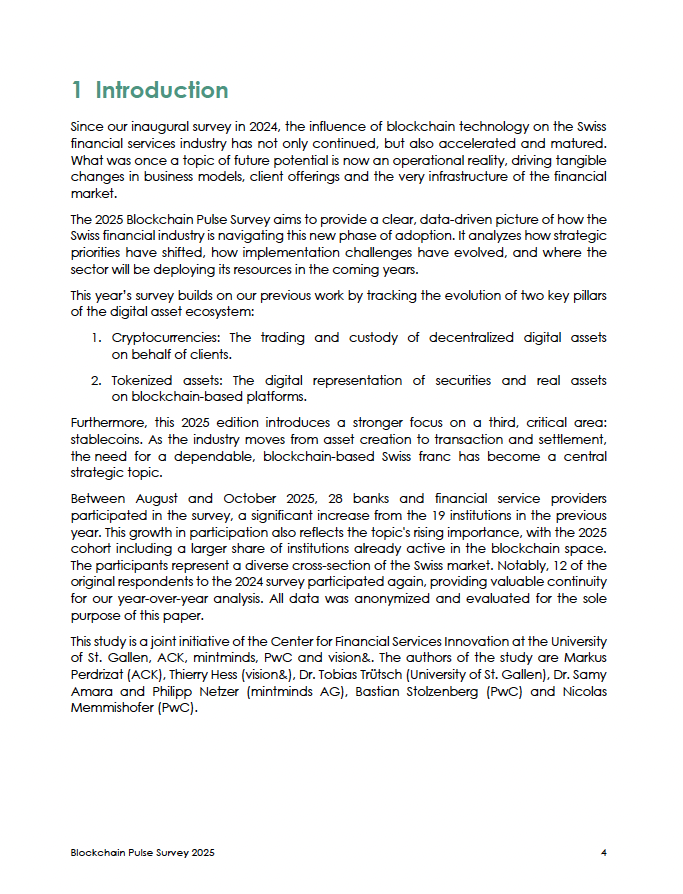
We have just released the new Blockchain Pulse Survey 2025 which is now available for download. The latest edition shows that blockchain is no longer a future experiment for the Swiss financial sector – it has become part of day-to-day strategy and execution.